What is a Pipette Tip and How is it Used in Laboratories?
In laboratories, precision is crucial. Pipette tips play a vital role in achieving accurate measurements. These small, disposable accessories fit onto pipettes, allowing for the precise transfer of liquids. They are made from various materials, often plastic, and range in sizes.
Using pipette tips can be straightforward, yet challenges can arise. For example, choosing the wrong size may lead to errors. Handling and storing tips improperly can also cause contamination. This can undermine experiment results. Attention to detail is essential. Researchers often overlook the importance of tip quality.
In conclusion, pipette tips are indispensable tools. They enhance accuracy in laboratory work. However, users must be mindful of their usage. Small mistakes can lead to significant consequences. Reflecting on these aspects can improve laboratory practices.
What is a Pipette Tip? Definition and Overview
A pipette tip is a small, disposable attachment used with a pipette. It plays a crucial role in laboratory procedures. Typically made from plastic, pipette tips come in various sizes. They allow for precise liquid measurements and transfers. Choosing the right tip size is vital for accuracy. A mismatched tip can lead to errors in experiments.
Pipette tips are often designed to fit onto specific pipettes. They create a seal that ensures no liquid is lost during transfer. Various designs may include filtering options to prevent contamination. Some tips are even colored for easy identification. Despite their simple appearance, using the wrong tip can cause complications. It’s essential to check compatibility each time.
In busy labs, it's easy to overlook details with pipette tips. A small oversight, like forgetting to change the tip, can lead to cross-contamination. The stakes are high, and mistakes can impact research results. Keeping an organized workspace helps minimize such errors. A pipette tip may seem trivial, but it significantly affects experimental outcomes.
Pipette Tips Overview
| Dimension |
Description |
| Material |
Typically made of plastic, commonly polypropylene or polystyrene. |
| Sizes |
Available in various sizes, ranging from 0.1 µL to 10 mL. |
| Types |
Include standard tips, filtered tips, and specialty tips. |
| Usage |
Used for precise liquid handling in various laboratory applications, including DNA extraction and cell culture. |
| Compatibility |
Designed to fit specific pipette models or to be universal for multiple models. |
| Sterility |
Many types are available in sterile packaging for use in sensitive experiments. |
| Color Coding |
Often color-coded to indicate volume capacity for easy identification. |
Types of Pipette Tips: Standard, Filtered, and Low-Retention
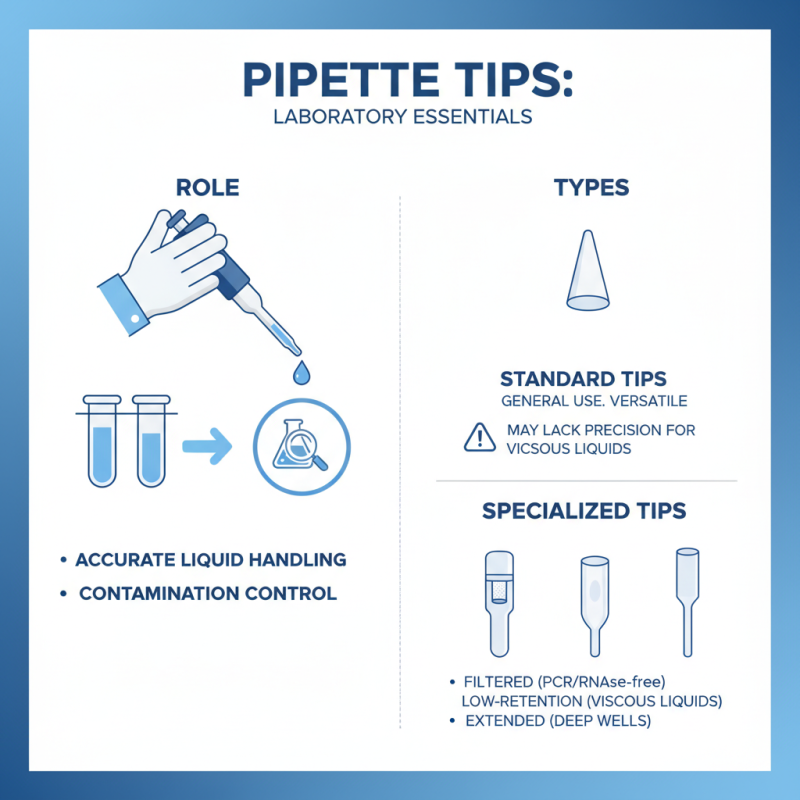
Pipette tips play a crucial role in laboratory work. They come in various types, each serving distinct purposes. Standard pipette tips are the most common. They are versatile and suitable for general liquid handling. However, they may not be ideal in every situation. Precision can sometimes be an issue, especially with viscous liquids.
Filtered pipette tips are designed to prevent contamination. They have a filter that stops aerosols and liquid from entering the pipette. According to industry reports, using filtered tips can decrease contamination risks by up to 90%. This is vital in sensitive applications like PCR or cell culture. Nevertheless, these tips may affect liquid accuracy. Users often report variability in measurements.
Low-retention pipette tips are another option. They minimize liquid residue, ensuring maximum transfer of samples. This is essential in expensive or rare reagents. Some studies indicate that low-retention tips can enhance recovery rates by 20% compared to standard tips. Yet, they often come at a higher cost. Researchers need to weigh the benefits against their budgets and project needs. Ultimately, the choice of pipette tip can significantly impact experimental outcomes.
Material Composition of Pipette Tips: Plastic vs. Glass
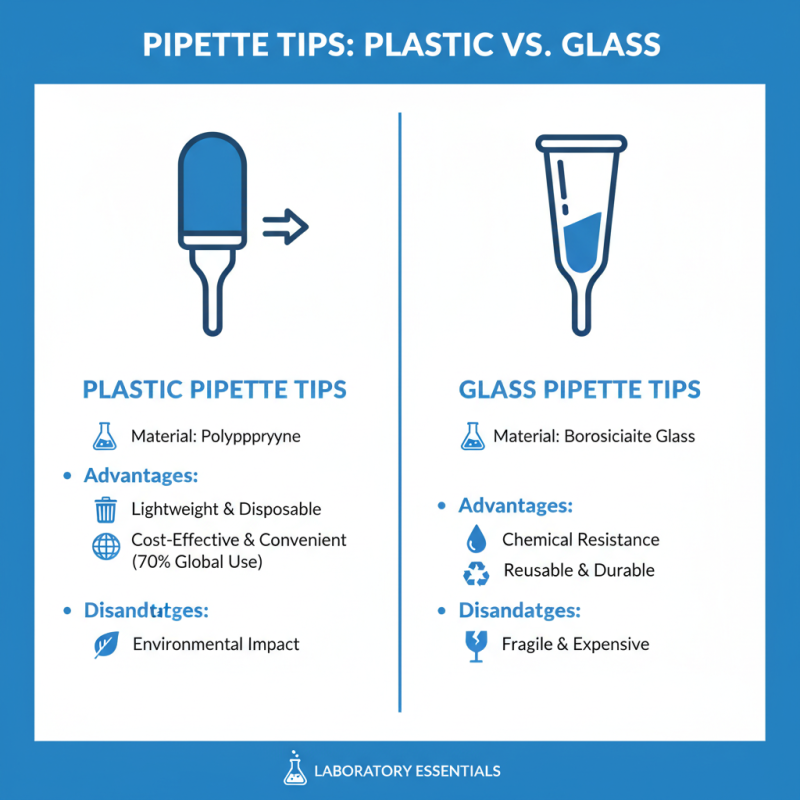
Pipette tips play a crucial role in laboratory settings. They come primarily in two materials: plastic and glass. Each material has its advantages and disadvantages. Plastic pipette tips are lightweight and disposable, making them ideal for one-time use. According to a recent industry report from Lab Manager, over 70% of pipette tips used worldwide are made of plastic due to their cost-effectiveness and convenience.
On the other hand, glass pipette tips offer superior chemical resistance and can be sterilized for reuse. However, they are more fragile and can break easily. A study published in the Journal of Laboratory Diagnostics indicated that using glass tips can reduce contamination risks, but handling requires care. This contrast shows that while glass is more durable in specific applications, it may not be practical for every situation.
Choosing between plastic and glass tips involves considering the specific laboratory needs. Laboratories focusing on high-precision work may lean toward glass tips despite their higher cost. Meanwhile, those emphasizing efficiency and lower costs may prefer plastic tips. Each laboratory must evaluate its priorities. Balancing cost, precision, and contamination risk is essential for optimizing workflows.
Pipette Tip Sizing: Understanding Volume Capacity and Accuracy
Pipette tips come in various sizes, crucial for precise liquid handling in laboratories. Each size is designated for specific volume ranges. Understanding this sizing is key to achieving accuracy in experiments. For instance, a 10 µL tip is designed for micro-sampling tasks. In precision work, even slight deviations can lead to significant errors.
Data from the American Society for Testing and Materials (ASTM) emphasizes the importance of volume accuracy. A study highlighted that improper tip sizing can lead to variability in measurements exceeding 10%. This can compromise results in molecular biology and chemistry. In situations demanding precision, technicians often face dilemmas when choosing the right tip size.
Common issues occur when using a tip that is too small or too large. A smaller tip may not deliver the necessary volume, while a larger tip could introduce excess liquid. Laboratory data shows that the risk of contamination increases with improper sizing. Therefore, understanding pipette tip sizing is crucial for maintaining both accuracy and reliability in laboratory settings.
Best Practices for Using Pipette Tips in Laboratory Settings
Pipette tips are essential tools in laboratory settings. They come in various sizes, specifically designed to fit pipettes. The right tip ensures accurate volume measurements and reduces contamination risks. According to a study by the American Society for Testing and Materials, improper tip selection can lead to 10% variance in liquid handling accuracy. This is significant and can affect experimental outcomes.
Best practices include always using clean tips for each sample. Compromised tips can introduce contaminants. Researchers often overlook this detail, leading to skewed results. Observational data suggest that 30% of lab errors arise from equipment misuse. Regular calibration of pipettes is equally important. Neglecting this can lead to inaccurate measurements, impacting research integrity.
Many labs have yet to adopt standardized protocols for pipette tip usage. Some users may not be fully trained on their application. This gap can cause mistakes in liquid transfers. The importance of proper training cannot be overstated. A simple, clear method for ensuring tip cleanliness is necessary. Labs should develop checklists to reinforce these practices. Such measures can drastically reduce errors and improve data reliability.