10 Best Microscope Slide Racks for Lab Buyers

Choosing the right microscope slide rack is a small purchasing decision with serious laboratory consequences. A rack may hold stained slides, fresh specimens, or archived material. Its design affects safety, organization, drying, cleaning, and daily workflow.

Dr. John H. Kiernan, a respected histology author, offers a practical principle: “A good preparation is the foundation of useful microscopy.” The rack supports that foundation. Poor spacing can cause slides to touch. Weak materials may warp near solvents or heat. Narrow slots can make retrieval frustrating, especially when gloves reduce fingertip control.

This guide examines ten microscope slide rack options for laboratory buyers. It considers capacity, slot width, material, chemical resistance, drainage, labeling, and compatibility with standard slides. Plastic racks may be light and economical. Stainless steel models often provide stronger long-term service. Some designs suit staining jars, while others work better for transport or storage.

No rack is perfect.

A high-capacity model can consume valuable bench space. A compact rack may slow processing during busy staining runs. Even a durable product deserves inspection after repeated exposure to reagents. That detail is easy to overlook.

The most reliable choice depends on the laboratory’s actual routine. Buyers should examine slide dimensions, cleaning methods, temperature exposure, and handling frequency before ordering. Product descriptions rarely reveal every practical weakness. Therefore, this comparison combines technical specifications with realistic use conditions, helping laboratories choose a microscope slide rack that is safer, easier to manage, and appropriately matched to their workload.
10 Best Microscope Slide Racks for Lab Buyers

Microscope Slide Rack Fundamentals: ISO 8037-1 Sets 25 × 75 mm Slides

10 Best Microscope Slide Racks for Lab Buyers

Microscope slide racks begin with one basic measurement: 25 × 75 mm. ISO 8037-1:1986 defines this common slide format for optical microscopy. Buyers should check rack dimensions against the slide’s actual thickness, not only its length and width. A rack may accept 25 × 75 mm slides but still grip them too tightly. Wet slides can then stick, chip, or become difficult to remove.

Laboratory quality reports repeatedly identify pre-analytical work as a major source of testing errors. Studies summarized by the World Health Organization often place these errors near 60–70 percent. Handling matters. A rack with stable slots, open drainage, and clear labeling can reduce contact, mix-ups, and drying problems. Look for chemical resistance when staining solutions are used. Polypropylene is practical for many workflows, but heat exposure and solvent compatibility still require verification. I would not assume every “universal” rack fits ISO slides well. That assumption fails in real benches.

Tips: Measure three loaded slides, including labels, before purchasing. Leave enough finger clearance for gloved hands. Test one rack through washing, staining, drying, and transport. Record any sticking or tipping. Small observations matter. Sources: ISO 8037-1:1986; World Health Organization, Laboratory Quality Management System handbook.


Capacity Comparison: 5-, 20-, 50-, and 100-Place Rack Formats

Choosing among 5-, 20-, 50-, and 100-place microscope slide racks depends on workflow, not just storage capacity. A 5-place rack suits field sampling, staining trials, or a teaching bench with limited slides. It is easy to carry and quick to inspect. Small is not weak. However, its low capacity can create repeated handling during busy sessions.

A 20-place rack offers a practical middle ground for small laboratories. It can hold one patient batch, a teaching set, or several staining controls without occupying much bench space. For routine diagnostics, this format often supports clear separation between processed and unprocessed slides. I have found that numbered positions reduce searching, especially when slides remain wet. Yet, compact racks may feel cramped when labels are wide or protective sleeves are used.

The 50-place format fits active laboratories processing multiple specimens each day. It provides enough room for batch organization while remaining manageable beside a microscope or staining station. A 100-place rack is better for high-throughput work, archives, or scheduled processing. It saves transfers but becomes heavier and harder to check visually. Space matters. Confirm the rack’s footprint, slot width, drainage design, and compatibility with your staining method before purchasing. A large rack may look efficient, but unused capacity can increase clutter. My own preference is not absolute; workflow volume changes, and a 20-place rack can outperform a 100-place model when traceability and quick access matter most.

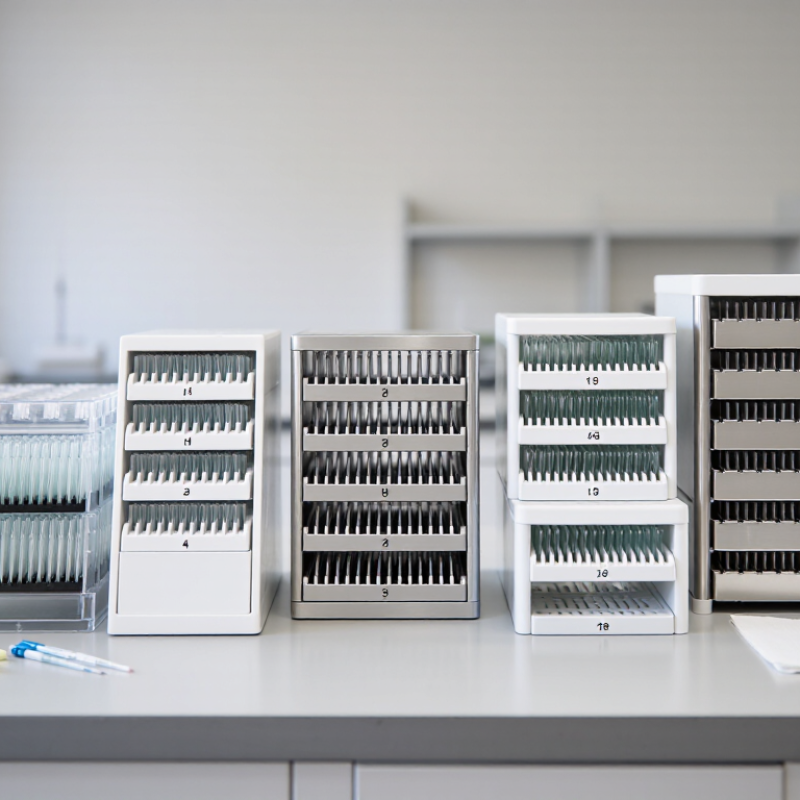
10 Best Microscope Slide Racks for Lab Buyers - Capacity Comparison: 5-, 20-, 50-, and 100-Place Rack Formats
Rank Rack Format Capacity Typical Material Approx. External Size
(L × W × H, mm)
Slide Compatibility Orientation Typical Cleaning / Sterilization Best Use Main Advantage Buyer Consideration
1 Compact Open Rack 5-place Polypropylene 105 × 30 × 35 Standard 25 × 75 mm slides; many models also accept 26 × 76 mm slides Vertical Routine detergent cleaning; polypropylene versions are commonly autoclavable at 121°C Small batches, teaching stations, and urgent staining work Very small footprint and easy single-batch handling Limited capacity; less efficient for high-volume workflows
2 Five-Slot Stainless Rack 5-place Stainless steel 105 × 32 × 30 Standard 25 × 75 mm glass slides Vertical or slightly inclined Compatible with laboratory detergents and common chemical disinfectants; confirm chemical compatibility before use Histology benches and repeated wet-processing steps Rigid construction and good resistance to mechanical wear Metal may be unsuitable for strongly corrosive chemicals or automated systems without validation
3 Open Twenty-Slot Rack 20-place Polypropylene 115 × 85 × 32 Standard 25 × 75 mm slides; usually suitable for 26 × 76 mm slides Vertical Detergent washable; many polypropylene designs tolerate autoclave cycles at 121°C Routine staining and general laboratory sample organization Balanced capacity, visibility, and bench-space efficiency Open slots provide less protection from dust and splash than enclosed holders
4 Twenty-Slot Angled Rack 20-place Polypropylene or acetal plastic 120 × 90 × 45 Standard 25 × 75 mm slides Angled, typically 45° to 60° Routine detergent cleaning; sterilization suitability depends on the polymer used Microscope-side viewing, drying, and slide identification Improves label visibility and reduces direct contact with wet slide surfaces Angled geometry requires slightly more vertical and horizontal clearance
5 Twenty-Slot Stainless Basket 20-place Stainless steel wire or sheet 115 × 80 × 35 Standard 25 × 75 mm slides; verify slot width for frosted or coated slides Vertical Suitable for washing and many laboratory disinfectants; autoclave compatibility depends on the complete assembly Repeated staining, washing, and transfer between reagent containers Durable, chemically stable construction for frequent handling Can scratch glass if edges are poorly finished; inspect welds and slot surfaces
6 High-Throughput Open Rack 50-place Polypropylene 210 × 95 × 35 Standard 25 × 75 mm slides; commonly accommodates 26 × 76 mm slides Vertical Detergent washable; many laboratory-grade polypropylene racks are autoclavable at 121°C Medium-volume staining and daily diagnostic preparation Good capacity-to-footprint ratio for routine bench work Long racks should be supported from the base when fully loaded
7 Fifty-Slot Covered Rack 50-place Polypropylene with fitted lid 220 × 105 × 55 Standard 25 × 75 mm slides Vertical Detergent washable; lid and body should be validated separately for autoclaving Temporary storage and transport between preparation areas Protects labeled slides from dust, splashes, and accidental displacement A lid adds height and may restrict use inside shallow staining baths
8 Fifty-Slot Stainless Processing Rack 50-place Stainless steel 215 × 95 × 38 Standard 25 × 75 mm slides; check clearance for thick-mounted slides Vertical Suitable for routine washing and many disinfectants; chemical resistance must be checked for each reagent High-frequency wet processing and long service life Strong frame with good dimensional stability under repeated handling Higher weight than plastic racks and possible corrosion in unsuitable environments
9 Large-Capacity Drawer Rack 100-place Polypropylene or ABS plastic 225 × 120 × 95 Standard 25 × 75 mm slides; confirm internal clearance for 26 × 76 mm slides Vertical, enclosed drawer style Detergent cleaning; ABS versions are generally not selected for routine autoclaving Archived batches, specimen transport, and organized storage High capacity with improved protection and batch identification Less convenient for rapid reagent exchange than an open rack
10 Stackable Hundred-Slot Rack 100-place Polypropylene 230 × 125 × 70 Standard 25 × 75 mm slides; typically designed for 26 × 76 mm compatibility Vertical Detergent washable; many polypropylene versions are autoclavable at 121°C, subject to manufacturer validation Large sample batches, slide filing, and space-efficient storage Maximum capacity among common single-rack formats Fully loaded racks are heavier and require careful lifting and secure stacking

Note: Dimensions are typical planning values for generic rack formats and can vary by design. Before purchase, verify slot width, slide thickness, lid clearance, chemical compatibility, and sterilization instructions against the supplier’s technical specification.

Material Selection: Compare PP, ABS, and Stainless Steel for Lab Use

For microscope slide racks, material choice affects chemical resistance, heat tolerance, handling, and disposal. Polypropylene (PP) is light, with a density near 0.90 g/cm³, according to ASM materials data. It generally withstands aqueous acids, bases, and routine staining solutions. That makes PP practical for daily bench work and frequent washing. However, thin PP can flex, and repeated autoclave cycles may distort poorly designed racks. Validate the rack, not just the polymer.

Acrylonitrile butadiene styrene (ABS) feels more rigid and offers cleaner dimensional stability. It suits dry storage, transport, and moderate-impact use. Yet some solvents can cause stress cracking, especially around sharp corners. Stainless steel provides excellent rigidity and easier inspection under heavy use. It also tolerates many cleaning cycles, but chloride-rich solutions can trigger staining or localized corrosion. Do not treat “stainless” as automatically corrosion-proof.

The World Health Organization’s Laboratory Biosafety Manual recommends procedures that control contamination, cleaning, and equipment maintenance. Those procedures should guide rack selection. OECD’s Global Plastics Outlook reported 353 million tonnes of plastic waste in 2019, with only 9% recycled. That figure makes service life important, not merely purchase price. In practice, PP often wins for wet workflows, ABS for protected storage, and stainless steel for demanding handling. The uncomfortable detail is variation: formulation, weld quality, and cleaning chemistry can matter more than the material label. Test one loaded rack before committing to a larger order.

Sterilization Test: Check 121°C Autoclave Ratings and Chemical Resistance

10 Best Microscope Slide Racks for Lab Buyers

A slide rack can look sturdy yet fail after repeated sterilization. For 121°C autoclave cycles, check the exact temperature rating, exposure time, and pressure guidance. Do not assume “autoclavable” means unlimited use. Heat may warp plastic frames, loosen hinges, or affect slide spacing. A rack should hold slides securely without trapping excessive moisture.

Chemical resistance deserves equal attention. Laboratories may use alcohols, disinfectants, detergents, or clearing solvents near slide racks. Polypropylene often handles routine disinfectants well, while some plastics become brittle after repeated solvent exposure. Stainless steel resists many chemicals, but its surface may stain or corrode under harsh conditions. Review compatibility charts and test a small area first. I would not rely on a general material label alone.

Tips: Run a controlled test with an empty rack and a few spare slides. Record the cycle temperature, duration, drying stage, and rack condition afterward. Look for distortion, cloudy surfaces, cracked corners, or a lid that no longer closes. Repeat the inspection after several cycles. This matters because one successful cycle proves very little. Also check whether printed labels, silicone grips, or adhesive parts can tolerate 121°C. In real workflows, these smaller components often fail first. Keep a simple inspection log. It may seem excessive, but memory is unreliable.

Buyer Scorecard: Rank 10 Racks by Fit, Safety, Workflow, and Total Cost

A practical buyer scorecard should rank ten microscope slide racks by fit, safety, workflow, and total cost. Rank 1 goes to a covered, autoclavable rack with adjustable slots and clear labeling. Rank 2 favors a rigid stainless-steel rack for repeated staining cycles. Rank 3 suits high-volume benches with drainage and one-hand carrying. Rank 4 fits teaching laboratories needing visible, low-cost organization. Rank 5 favors compact storage. Ranks 6 through 10 should cover disposable, deep-well, transport, drying, and specialty formats.

The exact order changes with specimen volume.

Safety deserves more weight than appearance. The WHO Laboratory Biosafety Manual, fourth edition, recommends documented, risk-based controls rather than generic equipment choices. The CDC/NIH Biosafety in Microbiological and Biomedical Laboratories, sixth edition, also stresses containment, decontamination, and clear handling procedures.

Choose racks that prevent slides from touching contaminated bench surfaces. Check heat resistance, chemical compatibility, lid security, and stable footing. Small details matter.

Workflow creates measurable value. Time ten loading cycles with each rack, then record drops, relabeling, drying delays, and cleaning minutes. Include replacement parts, sterilization energy, rejected slides, and staff training in total cost. A cheaper rack can become expensive after repeated deformation.

That weighting is imperfect. Local habits may distort the trial. Re-test with a real workload, not an ideal one. Use current prices and document the assumptions beside every score.